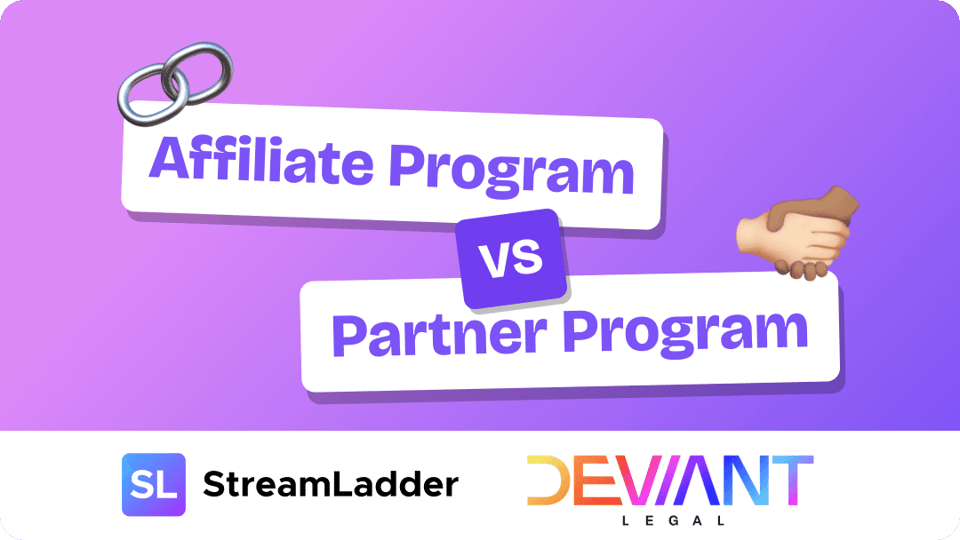
Many of you creators might catch yourself looking at your goal list and thinking - "how do I actually secure some partner and affiliate programs and push my reputation as a creator?" It's a daunting task for sure, but definitely a sign that you're stepping in the right direction on your content creation journey.
But before you go out and apply for these programs, partnerships, and sponsorship deals that you've seen other streamers secure, it's important to take a step back and give a careful eye to the fine print! Understanding the differences between the two and what's involved should be what ultimately shapes your decisions as a creator.
We here at StreamLadder and Deviant Legal want to help you approach these opportunities with as much care as excitement with our legal and practical advice below!
Defining Affiliate vs Partner Programs
Across industries, these programs can look very different and even vary in style by the company! No one program is going to look the exact same as the next, but there are patterns across each type that should be looked out for - especially to ensure you're receiving and providing exactly what should be expected of you.
What is an Affiliate Program... legally!
When you become an affiliate for a brand, you will enter into an affiliate agreement. This is an agreement where a brand rewards you for each view, click, lead or sale which is realized by your promotional efforts.
Typically, affiliates receive a referral link, a creator code or another tracking method. The better your performance, the higher your compensation. So essentially you do not receive a set compensation per month, but rather a success fee.
The advantage of an affiliate program for a creator is that the agreement often does not contain many obligations with regards to promotional output. Of course you need to adhere to the brand guidelines, but you won't often see that you are required to produce a certain amount of content to promote a brand. This also makes sense, because of the success-based structure: you can determine for yourself what the best way to promote is. And if you succeed, you get paid.
The disadvantage of an affiliate program is the insecurity regarding payments. This is often also the most complex element of the agreement, as it should clearly define what kind of conversion has to be realized in order to receive your compensation, without legal loopholes. You should ask yourself questions like: "what happens if someone visits the brand through my link, but only decides to buy something a week later and then visits the brand website directly?", "what happens with leads after the affiliate agreement ends?" and many more.
Additionally, there should be some kind of system introduced in the contract in order for a creator to verify how many clicks, leads or sales have been realized. This is often done by agreeing that a brand will send you reports. These reports can then be checked with an audit clause, which is actually really useful if something feels off. In most cases, this check is done by appointing an independent accountant to verify the calculation.
So from a legal perspective, affiliate agreements normally provide for a lot of flexibility for a creator to monetize their community. However, a creator does face a lot of financial insecurity and does often receive little support from the brand involved. Affiliate deals are not negative, but because of the success fees involved, it needs some extra thought.
What is a Partner Program... legally!
When you become a partner for a brand, you will enter into a partnership agreement. This agreement includes a more close-knit collaboration with the company, where the focus is less on value for the creator through compensation and more around being involved and personally connected with the business. This isn't to say that partners can't also be involved in paid advertisements or sponsorships, but this factor is not considered a constant feature of these programs. As a partner, you're less there purely for extra traffic and attention, and more so a collaborator with the team that helps push its brand and commercial appeal forward through your content creation.
A partnership agreement mostly includes an effort-based compensation: you are paid for content delivery, campaigns or for other kinds of efforts. This is a clear difference with the affiliate agreement, where you get paid for direct sales and conversions.
This compensation can be offered in various shapes and forms, including hourly rates, fees per content deliverable, monthly retainers, commissions, equity, perks or a mix of them.
From a contract perspective, a partner agreement often includes more rights and obligations for both parties. This is quite logical, because you are entering into an ongoing strategic relationship.
One area where this is clearly visible are the obligations regarding the content that you will produce. A partnership agreement contains more clauses regarding the amount of content you need to produce, the brand guidelines you need to adhere to, and the approval procedure which has to be followed in order for the brand to check your content before placing it online.
Additionally, partner agreements often include rights to your content. Often your content (including the brand) is licensed to the brand, so that they can use your content on their social channels as well. In very rare cases, some brands even require you to assign the content to them, essentially making them the owner of the content.
Another important point to consider is exclusivity. Partner programs often restrict creators from working with competing brands within the same product category in order to protect the company's brand and market position. These clauses can significantly limit a creator's ability to enter into other collaborations, which is why it is essential to carefully review exactly how broad the restriction is.
This becomes especially important when a company operates across multiple product categories. For example, you may enter into a partnership focused solely on headsets, but unintentionally agree to restrictions that also prevent you from collaborating with other brands for keyboards, microphones, or other peripherals simply because your partner brand also sells those products. Creators should therefore pay close attention to how "competing products" and "product categories" are defined in the agreement.
Watch out for affiliates silently turning into suboptimal partnerships
Understanding the difference between affiliate and partner programs is important for one key reason: companies sometimes gradually increase expectations without formally changing the nature of the collaboration or the compensation attached to it.
In practice, creators often start out as affiliates with relatively limited obligations. The arrangement is straightforward: the creator promotes a product or service and receives compensation based on performance, such as clicks, conversions, or sales.
However, as a creator becomes more successful, companies may begin requesting additional involvement. What started as simple success-based promotion can slowly evolve into mandatory posting schedules, event appearances, exclusivity obligations, approval procedures, community engagement requirements, or other responsibilities that go far beyond basic affiliate marketing.
The problem is that the compensation structure does not always evolve alongside those additional expectations. Creators may still be compensated purely through commissions, even though the collaboration increasingly resembles a partnership.
The reverse situation can also occur. Some companies market a program as a "partner program" because the title sounds more prestigious or collaborative, while in reality the relationship functions almost entirely like a standard affiliate arrangement with little actual collaboration or support.
That is why creators should look beyond the label of a program and instead focus on the actual obligations, the level of control, the exclusivity requirements, and the compensation structure.
If you notice that the expectations placed on you are expanding beyond what was originally agreed upon, it is perfectly reasonable to ask the company for clarification.
Regardless of whether you're classified as an affiliate or partner, what matters most is that you should be comfortable with your position, that the tasks and responsibilities should not differ from what you agreed upon and your compensation should match the work you are putting in.
Contract Structures - Myths regarding negotiating contracts
Among content creators, there are several common myths regarding negotiating contracts. These myths often make content creators hesitate to stand up for themselves, when they definitely should.
The deal is not negotiable
When you get an offer from a company that wants to partner up with you, it sometimes feels like a gift. However, you should always remember that you realize your own value. While it is understandable that you feel flattered when someone shows interest in your content, you should not forget that it is a commercial business opportunity for the partner as well.
If a company genuinely believes in the commercial potential of your content, they also have a genuine interest in a mutually beneficial deal. Nobody will let a great opportunity walk away, only because you want to update some of the terms. Of course, some terms might be essential for a company, but that's what you find out during the negotiation.
The partner will be angry and/or annoyed when I engage a lawyer
We get that the idea of reaching out to a lawyer is scary. After all, it feels so serious and real. However, we have never seen that engaging a lawyer to review and negotiate an agreement will lead to anger and/or annoyance with your partner. And if it does, that is perhaps a red flag for the collaboration. After all, the only thing that you are doing is taking the collaboration seriously and making sure that it's balanced for both parties.
Engaging a lawyer has an additional benefit, because it allows you to focus on the relationship with your partner, while the lawyer can focus on the legal terms. This also has an additional benefit, because if any feedback of the lawyer backfires, you can essentially throw your lawyer under the bus: it's all included in the hourly rate! :-)
Contract Structures - Obligations regarding content
One of the most important things creators should consider before joining an affiliate or partner program is how much control they will retain over their content.
While many collaborations offer creative freedom, most agreements still contain rules about what type of content you may create, how the brand may be represented, and what behaviour or statements are prohibited.
Understanding these restrictions is essential before you dive into a collaboration, especially if this may affect your usual style, audience or content format.
First of all, a lot of partnership agreements may include a system where you need to submit your content for approval in case it is content that concerns the brand. The brand then has a certain period of time to accept or to request changes. The most important thing here is to determine the assessment criteria.
Secondly, the agreement often contains obligations with regards to your content and your behaviour. This could include a prohibition to create content that is defamatory, discriminatory, obscene, religious or otherwise unacceptable to the brand. Other examples that can be added are the exclusion of the use of AI or the guarantee that you are the creator of the content yourself. The way this is phrased in a contract is usually along the lines of:
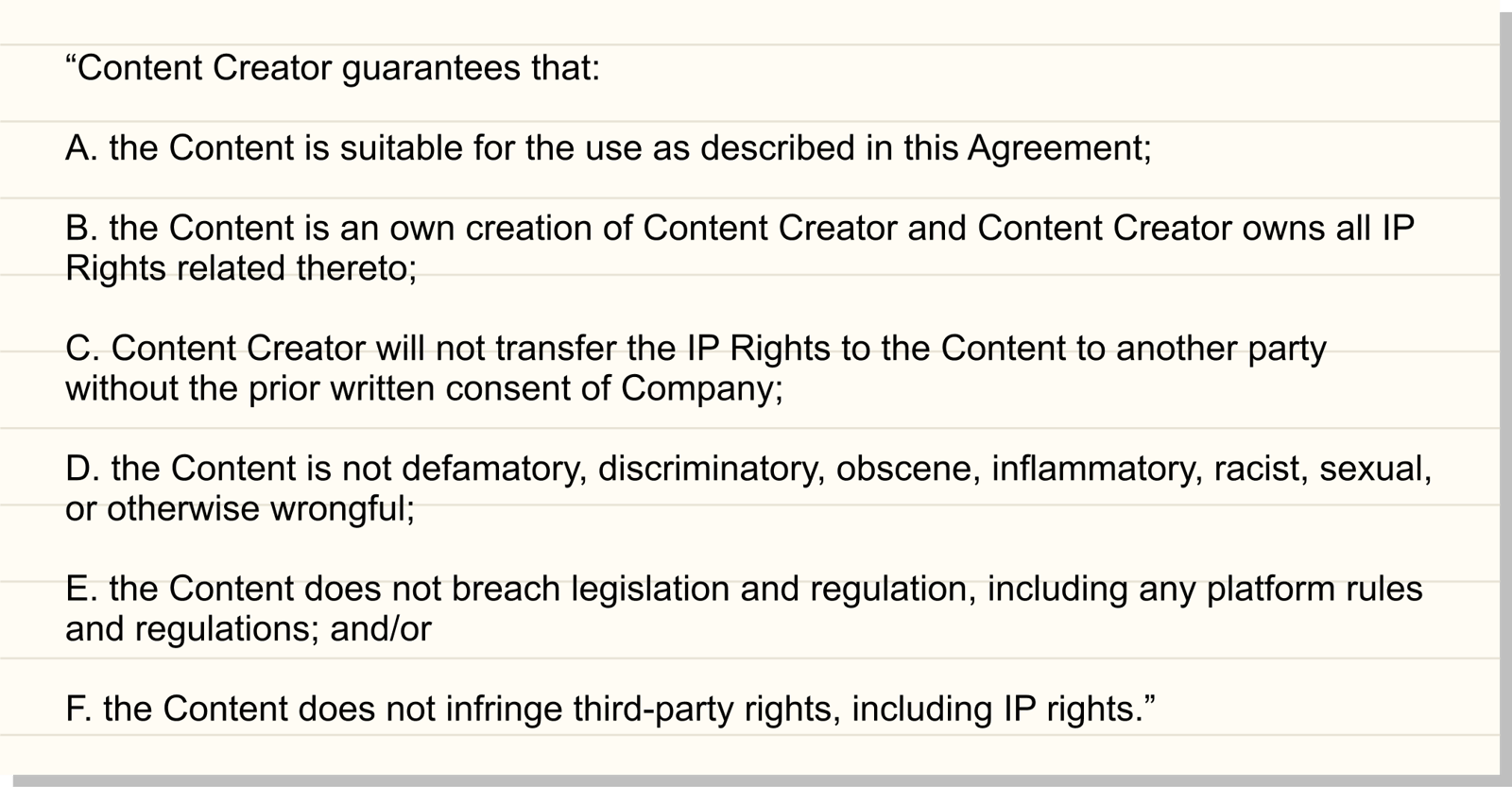
Breaching these guarantees can have serious consequences. Depending on the terms of the agreement, the company may be entitled to terminate the collaboration, withhold or reclaim compensation, impose contractual penalties, or hold the creator liable for damages resulting from the content.
In addition to the legal and financial risks, disputes involving inappropriate or infringing content can also negatively affect a creator's reputation and reduce future opportunities for affiliate or partnership collaborations.
Contract Structures - A few red flags to watch out for
One of the most asked questions by content creators is about red flags. This is a difficult question to answer in general, because red flags depend heavily on the context of the deal.
In our experience, the biggest risks usually do not come from a single clause in a contract. Instead, they arise from how multiple clauses interact with each other. When combined in the wrong way, otherwise common provisions can create harmful loopholes that place content creators in a very vulnerable position.
A few examples:
1. Vague assessment criteria for content
Many agreements give companies approval rights over content before it is published. While that is common and often reasonable, problems arise when the contract does not clearly explain how content will be assessed.
For example, a clause stating that "content must be approved to the satisfaction of the brand" can create significant uncertainty. Without objective criteria, a company could repeatedly reject content based on vague or subjective concerns, resulting in endless revisions, delayed campaigns, or even withheld payments.
This becomes especially problematic when deadlines depend on approval, payment is tied to acceptance, or the contract does not limit the number of revision requests.
Creators should therefore look for clear deliverables, objective approval standards, reasonable revision limits, and defined response timelines.
2. No protection against IP infringing materials provided by brands
Brands often provide creators with materials such as logos, music, gameplay footage, trailers, graphics or marketing assets. However, some contracts still place the full responsibility for intellectual property infringement on the content creator, even when the infringing material was provided by the brand itself.
For example, imagine a company provides music for a sponsored TikTok campaign, but it later turns out the company did not properly license that music. If the contract contains broad liability or indemnity clauses, the creator could still become responsible for copyright claims, takedowns, or damages.
Creators should therefore check whether the agreement includes protections confirming that the company owns or properly licenses the materials it provides, and that the company remains responsible for claims relating to those materials.
Without those protections, creators may unknowingly assume legal risks they cannot properly control.
3. No clarity regarding confidentiality
Confidentiality clauses are especially important in creator partnerships where you often work with unreleased products, early-access content, or private business information.
Problems arise when confidentiality obligations are drafted too broadly or too vaguely and you don't know whether you are allowed to discuss certain aspects of unreleased products.
This becomes even more complicated for livestreamers and content creators because live content is often spontaneous and difficult to fully control in real time.
A vague confidentiality clause can therefore create uncertainty about what is actually allowed, increasing the risk of accidental breaches.
Creators should look for agreements that clearly define what information is confidential, what may be discussed publicly, when embargoes expire, and how long confidentiality obligations continue.
What to Take Away
It's important to consider both the practical and legal sides to these programs - and of course, the contracts involved! It can be overwhelming, but you're not alone. If you ever feel lost by a contract and you do not know whether the clauses you noticed are red flags, don't hesitate to reach out.
Considering Affiliate and Partner Programs is a major step in your streaming and content creation journey. And while it can be daunting at first, there are resources and tools out there to lead you through the process!
When you need some freshly clipped content or high-quality edits for your first promotional campaign, StreamLadder is there to help you impress.
And for when you are being offered an affiliate or partnership deal, it is good to know that Deviant Legal offers free online legal consultation for creators. You can schedule your own via deviantlegal.com/free-consultation.